
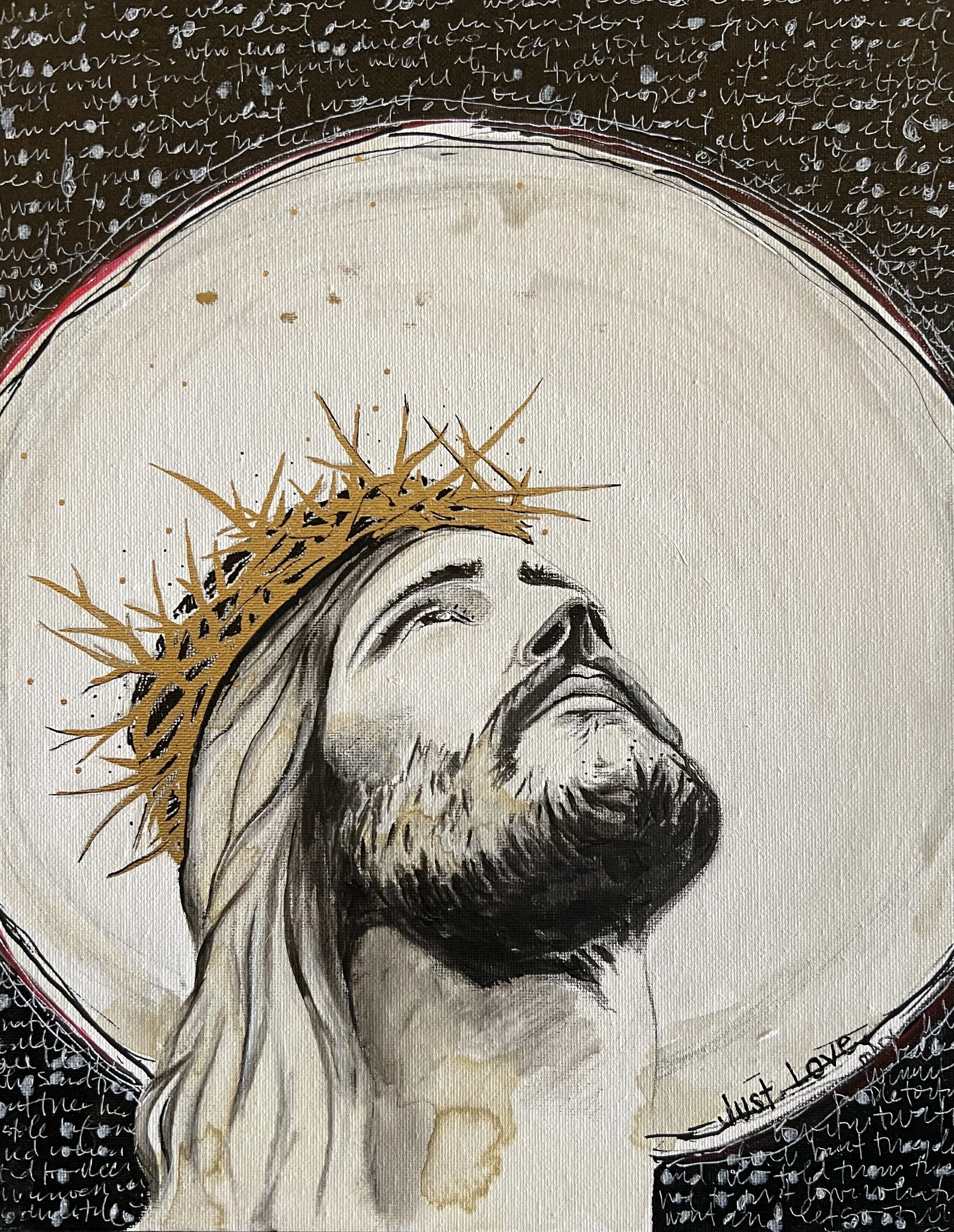
Jesus 2/52
Painting 2 of 52 influential people, “and so they changed the world.”
Medium: Canvas Board, Graphite, Coffee, Acrylic Paint, Oil Paint, Felt Tip Pens, Fine Tipped Acrylic Markers
Color Theory: Red to signify the blood of Jesus and to make people stop and pay attention. Red surrounds the white circle of love or life and separates it from the darkness, which signifies death. The combination of black and white establishes maximum value contrast and further showcases the lightness and darkness of the world. Gold represents the holiness of Jesus.
September 27, 2026
We always think we can do it better, faster and have similar or even greater outcomes than what we see reflected around us in nature. This is the culture of the world we live in. Consume. Hurry. Achieve. Repeat.
But if we stop, rest and just observe, we’d see that there is important work being done every day, all on its own.
We have good intentions, yet we are in such a hurry that the outcome is always the same. We create systems that fail, we slap on a bandaid and then use the time in between the quick fix and the inevitable failure to find a stronger bandaid.
What we need to do is stop and go back to our roots. We need to slow down and see what Jesus was actually trying to tell us without still holding on to the broken world we created.
I had a therapist once, I was suffering an immense loss. I was having a hard time letting go and moving on. She told me, “ you can't have a prince when you won't let go of the dragon.”
We can't fully grasp what is righteous, unless we let go of what is not. And this is not a one and done. This is a daily practice. My father once told me, after a loved one died, “if you want to honor them, do the things they did that made the world a better place.”
Jesus prioritized people over convenience.
Jesus practiced active mercy.
Jesus noticed the broken hearted.
Jesus served without expecting anything back.
Jesus showed constant patience with his followers, gently correcting their misunderstandings, calming their fears during storms and forgiving their repeated doubts and failures.
When he was confronted by critics or enemies who tried to trap him or mock him, Jesus often responded with measured wisdom, composure and grace rather than retaliation.
During his trial and crucifixion, Jesus suffered without threatening revenge or losing his moral composure, doing right under intense pressure.
I love Jesus, I read the word of God and I practice what it says. Yet I see more emulation of Jesus outside the church than in.
To me, this doesn't discount what Jesus said, it only solidifies it. The narrow and unpopular path to righteousness is not a check list of religious rules, but a radical transformation of the heart.
Jesus was the ultimate master of life. Every action, word and response showed us how to live righteously. He taught us that this takes patience, and that you can’t master it like he did. It is a practice that grows over time. We’ll never be able to do it better than Jesus, but he showed us how and reassured us that if it takes our whole life, and if we are on the right path, we are still doing it right.
Be one of the few.
“Enter through the narrow gate. For wide is the gate and broad is the road that leads to destruction, and many enter through it. But small is the gate and narrow the road that leads to life, and only a few find it.” - Matthew 7:13-14