
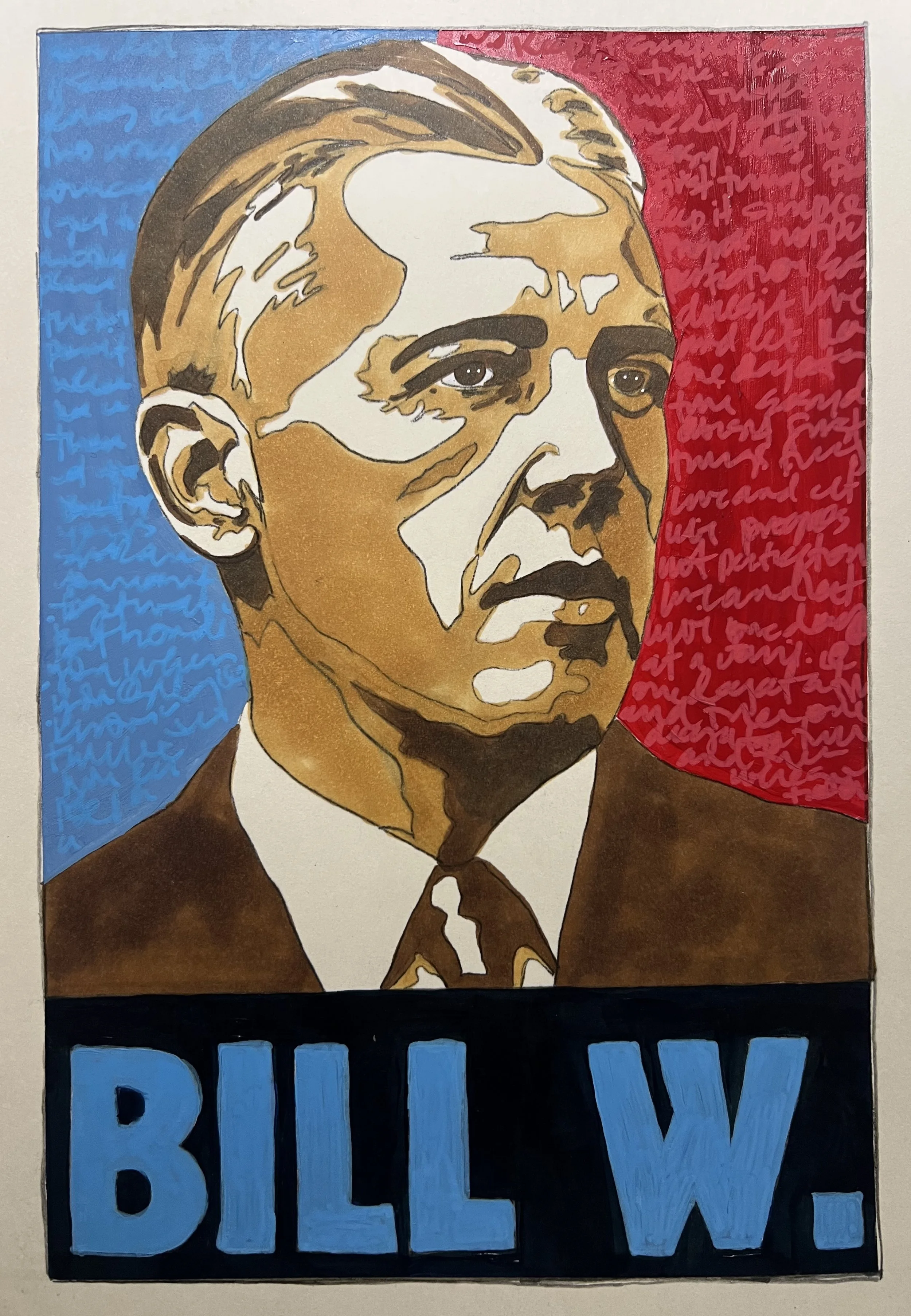
Bill W. 3/52
Painting 3 of 52 influential people, “and so they changed the world.”
Piece Name: Bill W. 3/52
Medium: Art Journal Page, Alcohol Markers, Acrylic Paint, Fine Tipped Pen.
Color Theory: Because he lived under the cloak of strict anonymity, the general public did not truly know the man behind the global movement until he passed away. Political content often stripes individuals of their private identities, making them an abstract representation of an idea or movement. As a political statement, I hope we can all see the need to elect people like Bill W., innovators that not only see and acknowledge a broken institution but actually do something about it. Bill saw the importance of the work, instead of getting high off the recognition. And I think even in death the importance remains the same.
October 4, 2026
Alcoholics Anonymous was born out of Bill Wilson's personal struggle with alcoholism—a relentless cycle of drinking, suffering losses, and repeating the pattern. Rather than dying in an asylum or ending up behind bars, he pioneered a program that would go on to save countless lives, including his own.
Without Bill W., my own story might have ended very differently. Thirty-eight years ago, my father found himself at the bottom of a hole he had dug, put down the shovel, and gave the program a chance. Roughly two decades later, I found myself trapped in a hole of my own making.
In search of an exit, I took advice from anyone willing to offer it—even those who were just as stuck as I was—which only caused me to sink deeper. It was only after reaching absolute rock bottom, a point where suffering reaches a threshold so unbearable that denial finally shatters and willingness takes over, that I finally asked my father for help.
He handed me The Big Book with simple advice: replace the word "alcohol" with whatever was blocking my spiritual growth—be it food, drugs, sex, or shopping. He reassured me that the book's principles could help anyone willing to apply them, and that whatever my specific struggle was, it was for me alone to know.
The trap with any form of numbing is that it rarely seems like a problem at first; it feels like medicine, shielding you from pain so effectively that you can eventually lose sight of the root issue entirely. But ignoring or concealing your problems only feeds them. After spending 5, 10, or 20 years heading in the wrong direction, turning your life around can feel far more daunting than staying numbed, which is precisely why reaching rock bottom becomes necessary.
Bill understood that to avoid falling back into old habits, people needed a compassionate community where they could be fully seen and heard without judgment. While AA's central mission is supporting individuals in achieving and maintaining sobriety, the impact reaches far wider. Today, the organization supports over 2 million active members globally, with millions more having built long-term sobriety over the decades. Just as active addiction ripples through families, so too does recovery.
We all carry something that causes us more harm than good. If "your thing" ever drags you into a place that feels less like living and more like a hole in the ground, take my advice and open the book.
Why Anonymity:
In the 1930s, alcoholism was widely viewed as a moral failure and a psychiatric dead end. Admitting to a drinking problem meant risking immediate employment termination, social ostracization, and marital collapse. When the first few dozen members achieved sobriety, they operated as a secretive underground network. Anonymity was a matter of basic survival. It created a safe haven where newcomers could seek help without fearing that their presence would be exposed to their employers or communities.
The tipping point for media anonymity occurred after journalist Jack Alexander published a groundbreaking profile on the fellowship in The Saturday Evening Post in March 1941. The article triggered a massive deluge of inquiries, causing membership to skyrocket from roughly 2,000 to over 8,000 members almost overnight. Bill W. and the early pioneers realized that if newly sober members began giving interviews using their full names and faces, the organization would rapidly lose control of its message and identity.
Bill W. observed a recurring, dangerous pattern: early members would get sober, declare their success publicly to the press, and subsequently experience a highly visible public relapse. When a public figure broke anonymity and then relapsed, the general public concluded that A.A. did not work. By mandating anonymity at the level of press, radio, and film, the
program ensured that the failure of any single individual would not destroy the credibility of the collective fellowship.
As A.A. grew, certain charismatic members began leveraging their sobriety for personal gain, selling their stories to newspapers or using their A.A. affiliation to boost political campaigns and business ventures. Bill W. recognized that personal ambition, money, and power were the greatest internal threats to the movement. He drafted the Twelve Traditions to counter this, specifically focusing on the media:
Tradition Eleven: "Our public relations policy is based on attraction rather than promotion; we need always maintain personal anonymity at the level of press, radio, and films."
Tradition Twelve: "Anonymity is the spiritual foundation of all our Traditions, ever reminding us to place principles before personalities."
By removing the incentive of personal fame, Bill W. successfully democratized the program. Anonymity forced every member—whether a Wall Street executive or a homeless newcomer—to enter the rooms on completely equal footing, ensuring the long-term institutional survival of Alcoholics Anonymous.